
Home
Services
Blogs
Properties
About us
Who We Are
Contact us

View our Info Hub
UPDATED ON 12 MAY 2026
Farmhouse Buying Process Explained: Step-by-Step Guide for Safe Land Investment
Everything buyers should understand before investing in farmhouse land near Delhi-NCR
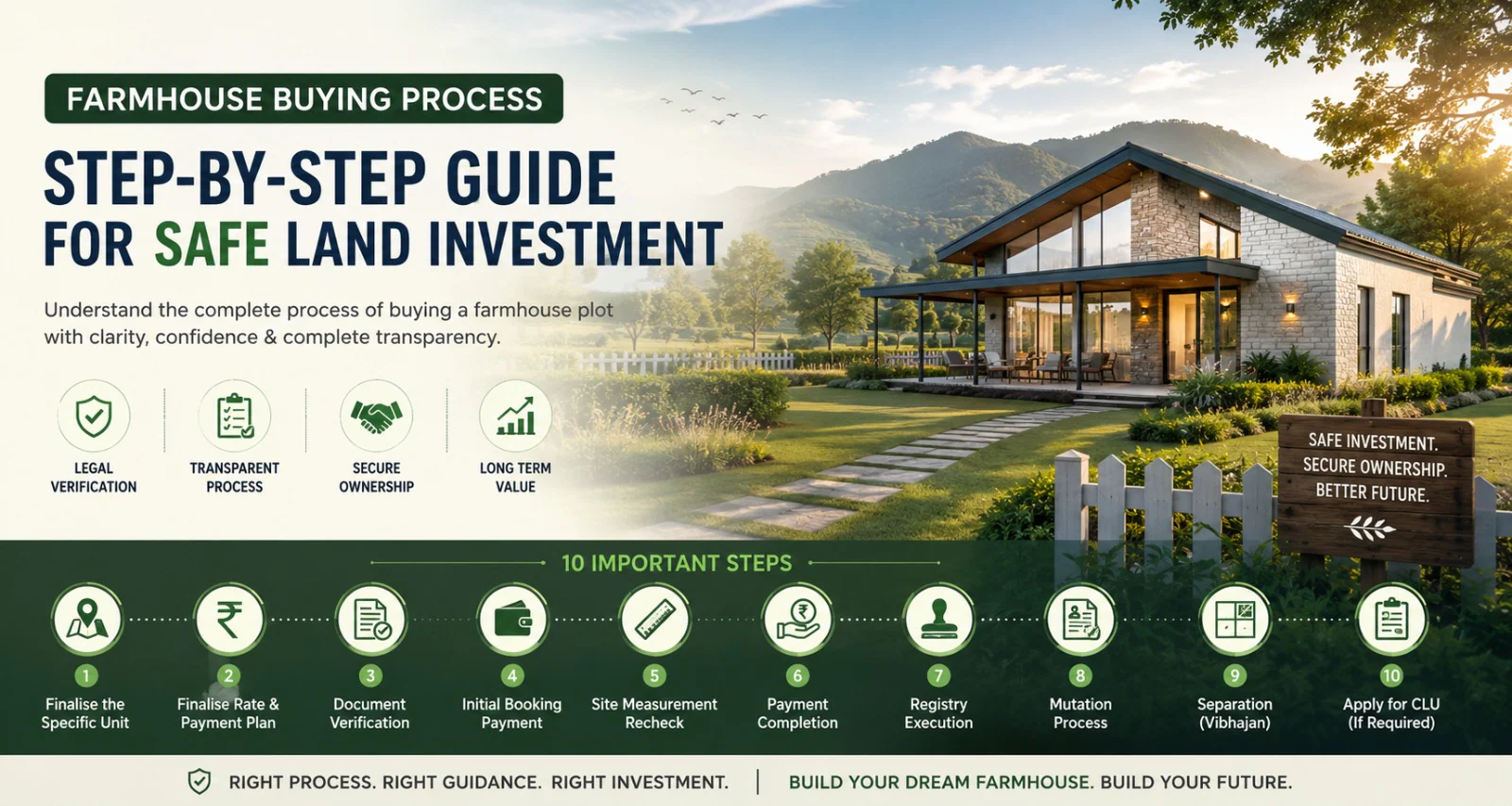
Farmhouse investments across locations like Naugaon, Alwar, Sohna, and nearby Delhi-NCR regions are growing rapidly. Better highways, rising demand for second homes, and increasing interest in land ownership have made farmhouse plots one of the most discussed real estate categories today.
But while many buyers focus only on pricing, location, and future appreciation, very few truly understand the complete process involved in safely purchasing a farmhouse plot. And that is exactly where most mistakes happen.
A farmhouse purchase is not just about selecting a piece of land. It involves legal verification, payment structuring, registry execution, mutation, and multiple compliance-related stages that directly impact ownership security and future usability.
To simplify the journey, here are the 10 most important steps involved in buying a farmhouse plot safely and correctly.
10 Important Steps in the Farmhouse Buying Process
- Finalise the Specific Unit
- Finalise Rate & Payment Plan
- Document Verification
- Initial Booking Payment
- Site Measurement Recheck
- Payment Completion
- Registry Execution
- Mutation Process
- Separation (Vibhajan)
- Apply for CLU (If Required)
Now let us understand each step in detail.
Step 1: Finalise the Specific Unit
The first stage is identifying and locking the exact plot or farmhouse unit within the project.
Buyers should carefully evaluate plot positioning, road connectivity, facing, dimensions, distance from the entry, and future development around the plot.
In organized farmhouse communities, different plots often carry different long-term value despite being part of the same project.
The goal is not simply to buy land, but to choose the right land.
Step 2: Finalise Rate & Payment Plan
Once the unit is shortlisted, the next step is freezing the commercial terms.
This includes final negotiated price, payment schedule, registry expenses, development charges, maintenance structure, and additional premium charges if applicable.
Many buyers only focus on base pricing and later discover additional costs.
A clear payment structure helps create transparency and avoids confusion later.
Step 3: Document Verification
This is one of the most important stages in the entire buying process.
Buyers should verify jamabandi records, khasra details, ownership chain, land classification, encumbrances, and government revenue records before proceeding with major payments.
In land investments, documentation clarity matters far more than marketing promises.
Step 4: Initial Booking Payment
Once verification is satisfactory, buyers usually proceed with a booking amount to reserve the selected unit.
This stage officially blocks the plot from further market availability and confirms buyer intent.
Proper receipts and documentation should always be maintained throughout the process.
Step 5: Site Measurement Recheck
Even after selecting the plot, physical site verification remains essential.
Buyers should check actual dimensions, boundary alignment, access roads, and physical positioning to ensure the ground reality matches the layout plan.
Experienced investors never rely only on brochures or maps before making major payments.
Step 6: Payment Completion
Once all checks are completed, buyers proceed with scheduled payments as per the agreed structure.
Proper receipts, payment proof, legal paperwork, and timeline tracking help protect ownership clarity and future resale value.
Step 7: Registry Execution
Registry execution is the formal legal transfer of ownership.
The sale deed is executed at the Sub-Registrar office, where the buyer officially becomes the legal owner of the property.
Buyers should ensure correct land dimensions, buyer details, khasra references, and stamp duty compliance during this stage.
Step 8: Mutation Process
After registry, mutation updates the ownership records within government revenue systems.
Mutation transfers the land records into the buyer’s name for future taxation and ownership recognition.
While many buyers think registry alone completes the process, mutation is equally important for maintaining clean ownership records.
Step 9: Separation (Vibhajan)
In certain projects, subdivision or separation processes may be required for individual plot allocation.
This process helps establish clear plot boundaries, independent plot identity, and proper subdivision recognition.
Step 10: Apply for CLU (If Required)
CLU, or Change of Land Use, may become relevant depending on future construction plans or intended usage.
This is particularly important for buyers planning farmhouse construction, hospitality usage, or long-term structural development.
Conclusion
Farmhouse investments can offer strong long-term value, lifestyle benefits, and future appreciation — but only when the buying process is handled correctly.
From land verification and pricing to registry and compliance, every step plays an important role in protecting your investment and avoiding costly mistakes later.
At Fynest Realty, we work on the buyer’s behalf to simplify the complete farmhouse investment journey — from project shortlisting and site visits to due diligence and final registry coordination.
Whether you are looking for a long-term investment, a weekend farmhouse, or a future-ready land asset near Delhi-NCR, our team can help you identify the right opportunity based on your goals and budget.
Call us today to discuss your farmhouse investment plans and explore the right options for you.
Trending Articles
View our Info Hub

Senior Living in India: Why It’s No Longer Just About Retirement

Oberoi Realty’s First Luxury Address in Gurugram: More Than Just Another Launch

Max Estate 360: A New Perspective on Luxury Living in Gurugram
Take the first step to financial
freedom and contact us today
Our team is ready to take you through every step of a successful property investment journey.
Make your move!

Join our
Community